.avif)




Vietnam is one of those Southeast Asian destinations that is on everyone’s bucket list. A country of striking natural beauty, vibrant culture, and deep historical significance. Its rich past is reflected in ancient temples, imperial cities, and reminders of resilience through decades of conflict and transformation. Vietnam’s landscapes range from emerald rice terraces and dramatic limestone cliffs to bustling coastal cities and tropical beaches, while its cuisine is celebrated worldwide for its fresh ingredients and bold balance of flavors, from fragrant pho and crispy banh mi to savory street food enjoyed in lively local markets.
Having lived as an expat in Asia for over a decade, I've been fortunate to visit Vietnam several times. I’ve built up quite a travel resume exploring not only the country’s famous attractions, but also the remote corners where tourists rarely visit. So when I had the responsibility of creating this Vietnam itinerary for Under30Experiences, I knew exactly what I wanted our travelers to see and do so they could fully immerse themselves.

Traveling to Vietnam with Under30Experiences will give you the opportunity to embrace the local culture and customs of Vietnam's Northern and Central regions. You’ll experience the blend of ancient tradition and modern energy in Hanoi, Vietnam’s capital city. You’ll get blown away by the natural beauty of Ninh Binh province, known for its dramatic limestone karsts and peaceful rice fields. As you make your way to the central coastline, you’ll glimpse into Vietnam’s royal heritage in the former imperial capital of Hue. Close out your journey through Vietnam by walking the lantern-lined streets of Hoi An’s Ancient Town.
Here are my trip highlights, and all the things to do in Vietnam on your next adventure!
9 Days in Vietnam: My Travel Itinerary
Day 1: Arrival in Hanoi
Our accommodation is located near Hoan Kiem Lake, a scenic area nestled right in the heart of the city. Once we settled in, we joined a welcome meeting with our Trip Leader, Kien Vu. Kien laid out the itinerary for our week ahead, pointed out safety aspects of traveling in Vietnam, and introduced us to the main aspects of Vietnamese culture.
Vietnam Travel Tip: Make sure you have cash on you. Although credit cards are accepted in many places, smaller establishments, including most street vendors, only take cash.
After our Welcome Meeting, Kien led us on an orientation walk around Hoan Kiem Lake and shared the mythical legend of Emperor Lê Lợi, who was given a magical sword by the gods to help drive out Chinese invaders in the 15th century. After winning independence for Vietnam, Lê Lợi was boating on the lake when a giant golden turtle emerged from the water and reclaimed the sword for the Dragon King, leading the lake to be named “Hoàn Kiếm,” meaning “Lake of the Returned Sword.”
On this first evening, we enjoyed a group meal of Vietnamese cuisine and continued to learn more about Vietnamese culture from Kien Vu while also getting to know one another while we ate.
Day 2: Explore Hanoi
Today’s agenda was to learn a bit about Vietnamese history and culture, while also exploring the chaotic streets of Hanoi's Old Quarter.
We began with a short private bus ride to the Temple of Literature, one of Hanoi’s most important historical and cultural landmarks, originally founded in 1070 as a Confucian temple and Vietnam’s first national university. Other than learning about this site’s historical significance, we will all remember most of the hordes of school children that were also visiting on this day. Yes, their noise took away from the serenity of the gardens, but their energy and enthusiasm of wanting to show off their English skills to us was contagious. A good amount of our time was spent taking selfies, debating if Messi was better than Ronaldo, or showing off our blue eyes. We learned that a majority of these students came from rural areas that don’t often see foreigners, so we were definitely a highlight for them!

After saying goodbye and leaving our celebrity status behind, Kein Vu led us on a walking tour of Hanoi’s Old Quarter. We took in the sights and smells of local markets, observed the chaos of all the motorbike traffic, and learned that traditionally, the streets of the Old Quarter are named after the specific goods or trades once practiced there. Many street names still begin with the word “Hàng,” meaning “goods” or “merchant,” followed by the product historically sold on that street, for example, Hàng Bạc was known for silver shops, Hàng Gai for silk, and Hàng Mã for paper offerings and ceremonial goods.
After our walking tour, we were given some free time to explore the city on our own for the remainder of the afternoon. This is when a few others and I decided to get our first Banh Mi, a popular Vietnamese sandwich made with a light, crispy baguette that reflects the country’s French colonial influence, typically filled with a combination of meats, pâté, pickled vegetables, fresh herbs, cucumber, and chili sauce.
Vietnam Travel Tip: Make sure to research what you want to do during your free time. Hanoi has a lot to offer such as the Museum of Ethnology, Ho Chi Minh mausoleum, or just opt to keep it simple and relax at any of the comfortable cafes.
During our free time, a few of us visited Hoa Lo Prison, a historic prison originally built by the French in the late 19th century to hold Vietnamese political prisoners during the colonial era and later used during the Vietnam War to detain American prisoners of war. Others in the group took the opportunity to attend mass at Saint Joseph’s Cathedral since it was a Sunday.
Later that day, we all gathered together for a Hanoi Street Food Experience tour led by our Trip Leader, Kien Vu. Kien Vu navigated us around the Old Quarter once again. On our food tour, we sampled local fruits from street vendors, dined at one of Hanoi’s most famous pho restaurants, tasted grilled frog, and watched a demonstration on how to make egg coffee! And don’t worry, you get to taste the egg coffee as well.
After filling up our bellies, a few of us extended the night by grabbing some beers at Beer Street, one of Hanoi’s liveliest nightlife areas, while a few others walked over to Train Street.
Day 3: Ninh Binh Countryside
Today, we said goodbye to the city and headed out to the countryside. Let me tell you, the natural beauty of Ninh Binh did not disappoint! Eventually, the city skyline of skyscrapers and hotels gave way to peaceful rice fields and limestone karsts with water buffaloes bathing in the mud.
But, before exploring those natural areas, we stopped at the home of a local artisan to learn the art of To He, a traditional Vietnamese folk art made from colorful rice dough that is carefully shaped into miniature figures, animals, and characters. This particular family has been creating To He for 4 generations now and has been recognized for this artwork by Vietnam’s Department of Culture and Art.
Our workshop was a little over an hour long to which we were instructed on how to make flowers before being given time to use our own creativity to make our own. What’s really cool is that you can keep both toys that you make to bring home as a souvenir!
After our workshop, we continued our drive out to the countryside to another home of a local family who had whipped up one of the most delicious meals I’ve ever had! Chicken skewers grilled on lemongrass stalks, pumpkin curry, spring rolls, papaya salad, and fresh lychee plucked right off the tree! It was a feast, and the host’s garden home atmosphere was perfect for the ambiance.
Vietnam Travel Tip: Sunscreen will be a good friend of yours. Be sure to pack it. There is a good amount of time spent out in the sun, and not all sites visited will have the shelter of the shade.
Later that day, we boarded sampan boats, a flat-bottomed wooden vessel, and we paddled through the gentle waters of Van Long Nature Reserve. The scenery consisted of flood rice fields and gigantic limestone karsts, with herons and other birds flying about. It was a peaceful afternoon and a nice retreat into the wilderness.
Upon arriving at our accommodation in Ninh Binh, most of us took the opportunity to swim in the pool and relax before venturing out into the town for dinner and some drinks.
Day 4: Hang Mua Viewpoint
If you’ve ever researched Ninh Binh, there are two photos that come up most often: paddling through rice fields on a meandering river and another of stone steps leading up a mountain dragon statue. Well, yesterday we paddled through the nature sanctuary, which meant today we’d be hiking those steps!
Hang Mua was definitely not a place to miss. Yes, the steps are demanding. There are over 500 of them! But by taking one’s time and going at it at one’s own pace, the top is accessible for many. If you opt to not go all the way to the top, there are viewpoints half way up as well as boardwalks below that navigate through a series of lotus ponds. To sum it up, the area is beautiful and offers fantastic views from every angle. Plus, there are cafes at the site for you to purchase a cold drink or an ice cream.

After visiting Hang Mua, our group opted to rent bicycles for our second site visit that day. Once again, our trusty Trip Leader, Kien Vu, told us that traveling by bicycle in Ninh Binh offered up the opportunity to get off the beaten track. He then guided us along both paved and dirt roads of the Ninh Binh countryside, passing through local farms, crossing tiny bridges, and offering up incredible photo opportunities as we made our way to Bich Dong Pagoda. I believe I can speak on behalf of everyone in the group that this bike ride was a top highlight of the trip!
Vietnam Travel Tip: Either purchase a locally crafted handfan or bring along a portable handheld fan. The temperature in Vietnam does get high, and you should expect to sweat.
Before returning to the town of Tam Coc, Kien Vu took us to a small restaurant nestled in the rice fields for lunch. The restaurant had a duck pond on site and loads of baby ducks for you to play with as part of the experience. It was a cool experience, and the food was delicious too.
Later that afternoon, most of the group opted to relax by swimming in the pool and unwind from our day’s adventures. We had organized a late check out on this day, so rooms were accessible until we left for dinner that evening and then onwards to the train station.
Yes, what you just read is correct. This trip involves an overnight train journey from Ninh Binh to Hue. The train is air-conditioned, and each person has their own bed equipped with a blanket and a pillow. There are four beds per cabin, but the bathrooms are shared with others in the car. Bring earplugs and an eye mask if you are a sensitive sleeper due to the train’s rocking and lights flickering through the windows throughout your journey. But I can attest, it’s a comfortable ride, and most importantly, it was a good bonding session with the other group members in my cabin.
Day 5: Welcome to Hue
Upon arriving at the Hue Train Station, our private bus and new driver will be waiting for us. Then we’ll head to breakfast before visiting one of Hue’s famed garden houses.
Hue’s garden houses are traditional residences that blend elegant wooden architecture with carefully designed gardens, ponds, and courtyards to create a peaceful harmony between nature and daily life. These houses were once home to royal officials and noble families during Vietnam’s imperial era.
We were guided through the house’s compound to learn about the family’s history and to view the collection of artifacts and antiques that the house now holds.
Vietnam Travel Tip: Whether you are a coffee lover or not, don’t miss out on trying some of Vietnam’s famous coffee. You don’t need to drink it black either. You can try egg coffee, salted coffee, or coconut coffee!
For lunch, we dined on Hue’s famous Bun Bo, a rich and flavorful Vietnamese noodle soup, known for its spicy lemongrass-infused broth and hearty combination of beef, pork, and rice noodles. Bun Bo originated in Hue, so of course, one needs to taste it when visiting this city.
That afternoon, we had free time to explore Hue at our own leisure. A majority of us visited the Imperial City, a vast walled palace complex filled with ornate gates, royal temples, courtyards, and ancient halls. It’s a great way to continue learning about Vietnam’s imperial past.
That night we joined back together for an included group meal before heading out to Hue’s bar district for a few drinks with the locals.
Day 6: Explore Hue
Today, we visited the quieter, lesser-visited area of Bao Vinh trading town, known as Hue's "lost city". Other than our impromptu karaoke session with some elders, the highlight of the day was the Hue cake workshop, which was led by a local artisan and her daughter.
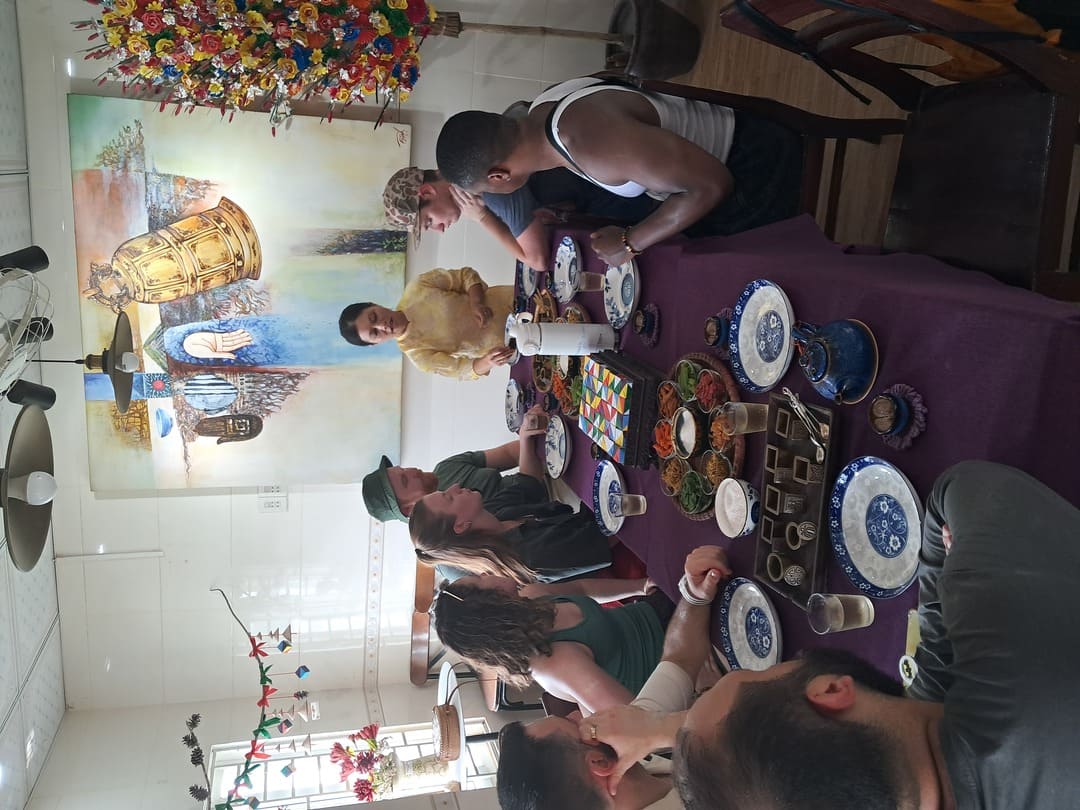
The family has been making traditional cakes in Hue for multiple generations, dating back to the imperial days. These colorful rice cakes and sweet treats are still seen as a tribute to Hue’s culinary heritage and imperial traditions. During our workshop, we learned the history associated with these cakes and also prepared our own cakes to eat and take away on our journey.
Vietnam Travel Tip: Hue is a peaceful river town that is home to a beautiful river front promenade. I spent a good amount of time walking along the river during sunset and at night. Life is slow and simple in Hue. Embrace it.
After lunch, we visited Tu Duc mausoleum, the final resting place of Emperor Tu Doc during the Nguyen Dynasty. The mausoleum blends traditional Vietnamese architecture with serene natural landscapes, with lotus ponds and pine trees surrounding the tomb. Kien Vu then brought us to a Buddhist temple nested in the forests not far from the Tu Doc mausoleum, so we can also gain a glimpse of Vietnam’s Buddhist heritage.
The evening was designed as a free evening at leisure, so our group asked Kien Vu to organize a dinner and show cruise along the Perfume River. It was a nice activity to close out the day and our time in Hue, while also getting to try on some traditional Hue clothing for photo ops!
Day 7: Hai Van Pass & Nam O Fishing Village
I was leaving the trip early, so this was my last day, but I was able to join the group as they traveled from Hue to Danang. Along the way, we stopped at Hai Van Pass, a spectacular mountain coastal road famous for its sweeping ocean views, winding curves, and dramatic scenery.
Vietnam Travel Tip: The road along Hai Van Pass is curvy. If you get motion sickness on roads like this, I strongly suggest you bring along meds for this ride.
I said my goodbyes to the group after dining on an amazing seafood lunch in Danang. As I headed to the airport, they continued on to Hoi An, where they would spend the final two nights on their trip.
Hoi An is famous for its beautifully preserved Ancient Town, glowing lanterns, tailor-made clothing, flavorful local dishes, nearby beaches, and peaceful riverside setting, making it one of Vietnam’s most charming and memorable destinations.
Day 8 and 9: Hoi An
During the group’s time in Hoi An, they took another countryside cycling experience to Tra Que Herbal Village. At the village, they participated in daily farming activities, took a hands-on cooking class, and enjoyed a herbal footbath and massage.

The group also toured Hoi An’s Ancient Town, a few got fitted for tailored-made suits, one traveler got a haircut, and a few others extended their time to relax on the nearby beaches.
The Bottom Line
Vietnam is amazing. Every time I visit, I’m blown away by the people, the landscape, the food, and the culture. With each trip, I learn something new. Kien Vu did an incredible job sharing his culture and lifestyle with us, and for providing us with a new perspective on how to see and appreciate Vietnam.
Vietnam really should be on everyone’s must-travel destination list. But most importantly, I got to experience Vietnam with a group of lovely people who made my trip 1,000 times better.
If you’re ready to experience the food, culture, landscapes, and connections that make this country so special, check out our Vietnam trip and start planning your own adventure.